









Amazon Video
レンタル配信

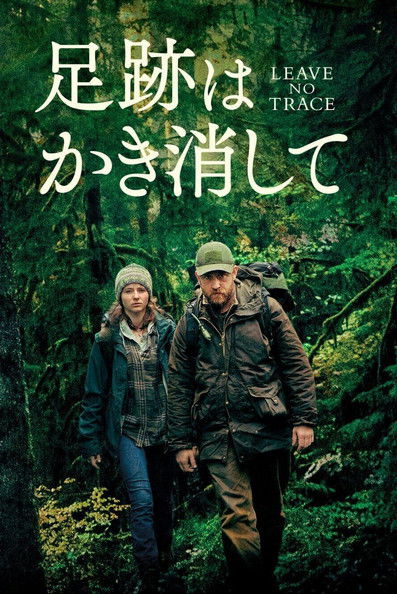
Leave No Trace
父と娘は、現代社会から逃れるように森林でひっそりと暮らしてきた。だが、2人は警察に見つかって社会復帰を促され、親子の日常ときずなが大きく揺らぎ始める。
WHERE TO WATCH
※ 配信状況や料金は変更される場合があります。リンク先で最新情報をご確認ください。
YOUR REACTION
ゾクログユーザーのリアクション
OFFICIAL TRAILER
動画提供: YouTube / Official Trailer
父と娘は、現代社会から逃れるように森林でひっそりと暮らしてきた。だが、2人は警察に見つかって社会復帰を促され、親子の日常ときずなが大きく揺らぎ始める。
 プロフィールを見る →
 プロフィールを見る →
 プロフィールを見る →
 プロフィールを見る →
 プロフィールを見る →
AUDIENCE REVIEWS
Hmmm, it **has** been a while since I've felt An Emotion™.
_Final rating:★★½ - Had a lot that appealed to me, didn’t quite work as a whole._
**_Deeply respectful of its subject_**
> _Society everywhere is in conspiracy against the manhood of every one of its members. Society is a joint-stock company, in which the members agree, for the better securing of his bread to each shareholder, to surrender the liberty and culture of the eater. The virtue in most request is conformity. Self-reliance is its aversion. It loves not realities and creators, but names and customs. Whoso would be a man must be a nonconformist. He who would gather immortal palms must not be hindered by the name of goodness, but must explore if it be goodness. Nothing is at last sacred but the integrity of your own mind._
- Ralph Waldo Emerson; "Self-Reliance" (1841)
In _Walden_, his 1854 memoir/philosophical treatise, Henry David Thoreau chronicles a period of two years, two months, and two days during which time he lived alone in a small cabin he himself had built in the forest near Walden Pond, Massachusetts, on property owned by his mentor and friend, Ralph Waldo Emerson. Inspired by the tenets of transcendentalism, of especial importance to Thoreau was "Self-Reliance", an 1841 essay by Emerson, which argues that an individual must avoid conformity, follow their own ideas and concepts, and trust in their own instincts if they are to attain a deeper understanding of the nature of existence. In _Walden_, Thoreau was putting this concept to the test, isolating himself from civil society, and existing in nature with only the barest means of subsistence;
> _I wished to live deliberately, to front only the essential facts of life, and see if I could not learn what it had to teach._
_Walden_ went on to become one of the (many) foundational texts of libertarianism, the core principles of which are the valuation of personal liberty above all else, and the encouragement of scepticism towards authority in general, and the state/government in particular.
All of which brings us to _Leave no Trace_, which could, perhaps, be described as a darker version of Matt Ross's _Captain Fantastic_ (2016). Directed by Debra Granik (_Winter's Bone_), and written for the screen by Granik and Anne Rosellini, based on Peter Rock's 2010 novel, _My Abandonment_, the film tells the story of Will (Ben Foster), a veteran suffering from PTSD, who is living off the grid with his daughter Tom (Thomasin McKenzie). Making their home in a national park in Portland, Oregon, they embody many of the concepts underpinning Emerson's notions of self-reliance; individual authority, nonconformity, solitude, internal self-truth, with Will especially valuing freedom of thought. However, when a jogger sees Tom, park wardens are dispatched to track them down, and social services open an investigation into their situation. Will is aghast, resenting the infringement upon his autonomy, recalling Iain King's statement that
> _autonomy should only be infringed if a person is unable to know their own interests on a particular matter._
This certainly isn't the case with Will, and he sees no reason why he and Tom shouldn't be allowed to continue to live in their own way.
None of the philosophical theories outlined above are explicitly mentioned anywhere in the film. However, knowledge of them definitely helps one to more easily understand Will. Whether Granik or Rosellini are even aware of these concepts is beside the point, as they serve to give one a more assured theoretical entry point into a not easily penetrated film. For example, does one have to know that Will is at stage six of Lawrence Kohlberg's stages of moral development to understand or enjoy the film? No, of course not. Does it help? Absolutely.
On a less theoretical note, the film does a lot that on paper would seem to be wrong; for long stretches of time, there is no real sense of any kind of standard Aristotelian conflict, as we simply observe Will and Tom going about their day. In tandem with this, the film is extremely light on plot, incident, and tangible character development, focusing instead on mood and tone, and calling upon the actors to externalise their emotions through action and expression rather than dialogue. Obviously, this means almost everything hinges on the quality of the performances and the believability of the bond between the characters. Thankfully, both Foster and McKenzie are exceptional – he plays Will as someone who has seen the darker side of humanity and has no time for frivolousness, whereas she plays Tom as someone desperate to have a childhood, but who also wants to make her father proud. In one particularly telling scene, when they must leave on a moment's notice, he tells her to pack only what is essential, and she places a toy horse in her backpack, but only after she has wrapped it up so Will can't see it, an action which tells us a great deal about both characters.
The film's pacing is both its greatest asset and its biggest flaw. To speed things up would have compromised the tone Granik is going for. However, this kind of methodical pacing is likely to alienate a lot of viewers, who will undoubtedly criticise the film as boring, and its focus on Will and Tom to the exclusion of almost everything else as too narrow. When it does branch out (for example, a minor sub-theme is the treatment of veterans upon their return to society), it is only insofar as to show how the two main characters are affected. What's especially interesting about the story, however, is that the narrative seems predicated on the transcendentalist notion of the inherent goodness of people; pretty much everyone Will and Tom encounter is trying to do right by them, even the social workers are genuinely trying to help them. In the end, what the film gives us is a deeply respectful portraiture of a man trying to make the best of it in the only way he knows how. A fine film.
口コミはTMDBユーザーによる投稿です。ゾクログの見解を示すものではありません。
RECOMMENDED FOR YOU
RECENTLY VIEWED






みんなの一言
まだコメントはありません。最初の一言を投稿しませんか?