








Amazon Video
レンタル配信

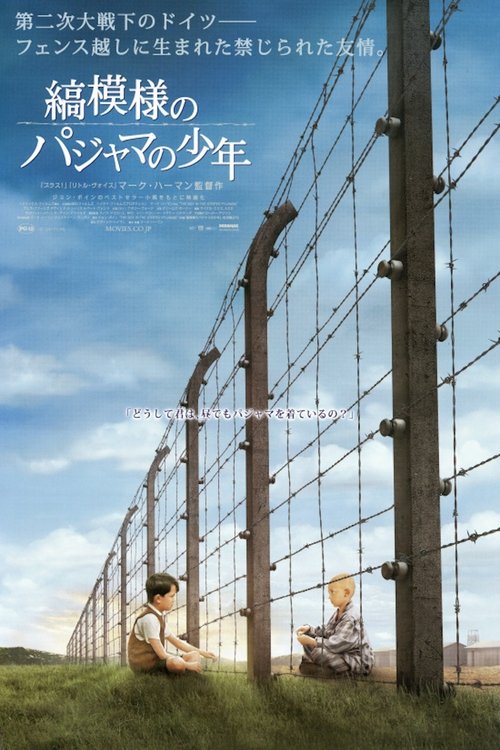
The Boy in the Striped Pyjamas
第二次世界大戦下、8歳の少年ブルーノは、ナチス将校の父の栄転でベルリン郊外に引っ越すことになる。裏庭の森の奥、鉄条網で覆われた場所を訪れたブルーノが出会ったのは、縞模様のパジャマを着た少年シュムエルだった。二人は友情を育むが、ある日ブルーノはシュムエルを裏切ってしまい……。<ナチス将校を父親に持つドイツ人少年と強制収容所内のユダヤ人少年との友情と哀しい運命を描いた心揺さぶる人間ドラマ。ジョン・ボイン原作の世界的ベストセラーを映画化。主人公となる二人の少年をオーディションで選ばれたエイサ・バターフィールドとジャック・スキャンロンが演じる。人種など問わない純粋な友情と、戦争がもたらす子どもたちの宿命に胸が痛む。>
WHERE TO WATCH
※ 配信状況や料金は変更される場合があります。リンク先で最新情報をご確認ください。
YOUR REACTION
ゾクログユーザーのリアクション
OFFICIAL TRAILER
動画提供: YouTube / The Boy In The Striped Pyjamas (2008) trailer
第二次世界大戦下、8歳の少年ブルーノは、ナチス将校の父の栄転でベルリン郊外に引っ越すことになる。裏庭の森の奥、鉄条網で覆われた場所を訪れたブルーノが出会ったのは、縞模様のパジャマを着た少年シュムエルだった。二人は友情を育むが、ある日ブルーノはシュムエルを裏切ってしまい……。<ナチス将校を父親に持つドイツ人少年と強制収容所内のユダヤ人少年との友情と哀しい運命を描いた心揺さぶる人間ドラマ。ジョン・ボイン原作の世界的ベストセラーを映画化。主人公となる二人の少年をオーディションで選ばれたエイサ・バターフィールドとジャック・スキャンロンが演じる。人種など問わない純粋な友情と、戦争がもたらす子どもたちの宿命に胸が痛む。>
第二次大戦下のドイツ── フェンス越しに生まれた禁じられた友情。「どうして君は、昼でもパジャマを着ているの?」
 プロフィールを見る →
 プロフィールを見る →
 プロフィールを見る →
 プロフィールを見る →
 プロフィールを見る →
AUDIENCE REVIEWS
Not convinced this is a greatly made movie, but it sure does pack a punch!
<em>'The Boy in the Striped Pyjamas'</em> makes for good viewing for the majority, though that ending really is quite something - startling in fact, and that's even with me sensing it. The aforementioned is because, as well as the way the film builds in general, I'm pretty certain I watched this at high school; just not sure if it was snippets or the whole thing, the fence scenes are the only ones I vaguely recall seeing.
The low acting level of the youngsters did take me out a bit, no dislike to Asa Butterfield and Jack Scanlon, obviously, but they aren't the best. Though they aren't helped by the dialogue for them, which doesn't feel natural at all. It's written in a way that is simply to tell the viewer about what's happening. The adult actors are great, though. Vera Farmiga stands out, though David Thewlis, Rupert Friend and David Hayman merit a mention too.
All in all, it's a good film - and one that is distressingly unforgettable thanks to that one moment.
**Summary: 2/10: well-acted, handsomely made, and morally inverted, a film so intent on manufacturing sympathy for a commandant's family that it forgets, or worse, quietly excuses, whose deaths it was supposed to be mourning.**
I haven't read John Boyne's novel, so I can't tell you where the book's failures end and the film's begin. I can only tell you what arrived on screen, and what arrived on screen is a Holocaust memory film that gets the craft right and the moral geometry catastrophically wrong.
The acting is not the problem. Asa Butterfield is believable as a bored, incurious eight-year-old; David Thewlis plays the commandant with the kind of clipped, unbothered domesticity that should be chilling; Vera Farmiga does real work with a woman coming apart. Mark Herman's direction is competent, the production values are handsome, the Hungarian locations convincingly evoke the machinery of the camp. None of that is in question.
What's in question is the premise itself, and premises are not neutral. The film asks us to believe that the wife and children of an Auschwitz-adjacent commandant would not know, would not smell it, would not hear it, would not notice the smoke or the silence or the trucks. This is not a small contrivance in service of a story; it is the whole architecture of the story, and it is a lie by omission dressed up as innocence. The fence a small boy could wander up to unsupervised and befriend a starving child through, in a scenario the book invented from nothing, did not exist. Real fences were guarded, real families of SS officers lived with full knowledge of what their husbands did all day, and children of that age in that world were not blank slates; they were being raised inside an ideology, at school, at the dinner table, in the language of their own household.
Stanley Kramer put the "we didn't know" defense on trial explicitly in *Judgment at Nuremberg*, decades closer to the events, and even there the film treats the claim as something to be interrogated and dismantled under oath. *The Boy in the Striped Pyjamas* extends the same claim, unexamined, to a grown household living on the literal grounds of a death camp, and then hands it to us wrapped in a child's point of view so we can't argue with it.
The film wants tragedy at the end, and it gets a shocking image, but the emotional target it hands you is the mother. We are meant to grieve with her, for her loss, for her broken family, for the horror visited upon her by her husband's job. That is the whole design flaw laid bare: after ninety minutes inside a story about the murder of hundreds of thousands of children, the tears the film has engineered belong to the family of the man responsible.
If you want to know what actual historical memory looks like, it looks like Claude Lanzmann's *Shoah* (1985), over nine hours of testimony from survivors, bystanders, and perpetrators, filmed decades after the fact, with no archival footage, no reenactment, no score, no comfort. Lanzmann refused every device that turns atrocity into narrative satisfaction, because he understood satisfaction was exactly the wrong thing to offer. *Conspiracy* (2001) refuses it too, letting bureaucratic language convict men without a single sympathetic domestic scene. *Labyrinth of Lies* is about nothing except the decades of denial this film's premise quietly extends onto the screen. *The Boy in the Striped Pyjamas* offers the opposite of all of them: a tragic ending, a swelling score, a mother to weep with, and calls it memory.
That is not historical memory. That is evil dressed in a nice coat.
口コミはTMDBユーザーによる投稿です。ゾクログの見解を示すものではありません。
RECOMMENDED FOR YOU
RECENTLY VIEWED





みんなの一言
まだコメントはありません。最初の一言を投稿しませんか?